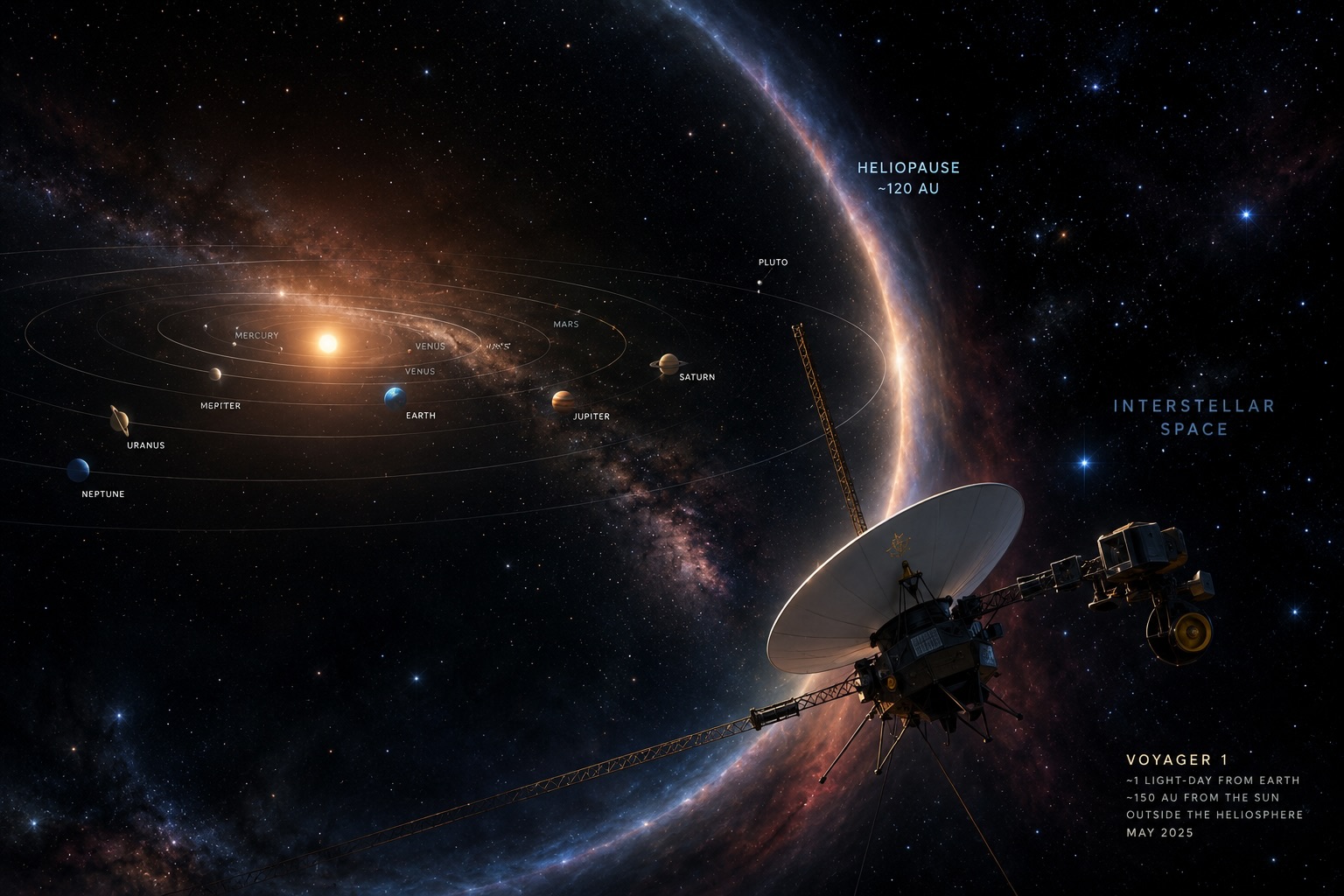
More than four decades after their launch, the twin Voyager spacecraft remain among humanity’s greatest engineering achievements. Launched in 1977, the two robotic explorers were originally designed for a relatively modest mission: conduct flybys of the giant outer planets and then continue into deep space. Instead, they became history’s longest-running and most distant spacecraft.
Today, Voyager 1 is more than one light-day from Earth. Put another way, a radio signal traveling at the speed of light takes over 24 hours to reach it. Voyager 2 trails behind but remains unimaginably distant. Both spacecraft are now moving through interstellar space, beyond the protective bubble of charged particles known as the heliosphere.
The Voyagers achieved this remarkable feat using technology that would seem primitive by modern standards. Their computers possess less processing power than a digital wristwatch. Yet careful engineering, gravity assists from the giant planets, and the reliability of their radioisotope power systems allowed them to journey farther than any spacecraft before them.
An obvious question follows: could we build something today that would eventually catch and surpass them?
The answer is yes—but not as easily as one might expect. The Voyager spacecraft are traveling at roughly 17 kilometers per second relative to the Sun. That may sound fast, but by modern standards it is not an insurmountable speed. In fact, several newer spacecraft have already achieved higher velocities. NASA’s Parker Solar Probe currently holds the record for the fastest human-made object. During close approaches to the Sun, it exceeds 190 kilometers per second—more than ten times faster than Voyager. If Parker Solar Probe were aimed outward instead of repeatedly looping around the Sun, it could theoretically overtake Voyager in a matter of years. The challenge is that Parker’s extraordinary speed comes from a carefully designed orbit that repeatedly falls toward the Sun.
Escaping the Solar System at such speeds requires a different mission profile. Even so, current technology offers several promising possibilities. Ion propulsion, already proven in space, can gradually accelerate spacecraft over months or years. Unlike chemical rockets, which provide a brief burst of thrust, ion engines sip electricity and continuously accelerate. NASA’s Dawn mission successfully used ion propulsion to visit multiple asteroids, demonstrating its efficiency.
A modern deep-space probe equipped with advanced solar arrays and ion engines could slowly build tremendous velocity. Such a spacecraft might eventually exceed Voyager’s speed by a significant margin, though it would still require decades to reach comparable distances.
Nuclear-powered systems offer another intriguing path. Radioisotope generators, like those powering Voyager, provide electricity but not propulsion. Nuclear-electric propulsion, however, could use a compact reactor to power extremely efficient ion engines. Studies suggest such systems could potentially propel spacecraft to speeds several times greater than Voyager’s.
More ambitious concepts push the limits even further. One proposal involves using the Sun itself as a giant slingshot. A spacecraft would dive extremely close to the Sun, protected by advanced heat shields, and then fire powerful engines at perihelion, where orbital velocities are highest. This technique, known as the Oberth maneuver, could dramatically amplify the effect of the spacecraft’s propulsion.
Another concept uses solar sails. These enormous reflective sheets are pushed by sunlight itself. While the acceleration is tiny, it never completely stops. Over years or decades, a sufficiently large sail could reach extraordinary speeds.
The most dramatic proposal currently under study is laser propulsion. The Breakthrough Starshot concept envisions Earth-based lasers accelerating tiny spacecraft attached to light sails. In theory, such probes could reach 20 percent of the speed of light—roughly 60,000 kilometers per second. At that speed, Voyager’s current distance would be crossed in only a few days. Unfortunately, Starshot remains far beyond current engineering capabilities. Building the required laser infrastructure would be one of the largest technological projects in human history.
So how fast could we realistically send a spacecraft with today’s technology? A dedicated deep-space mission using existing propulsion methods could likely achieve escape velocities in the range of 20 to 40 kilometers per second. With aggressive use of solar flybys and advanced electric propulsion, perhaps somewhat higher. Such a mission could overtake Voyager eventually, but not dramatically.
The real breakthroughs will likely come from nuclear-electric propulsion, solar-sail systems, or future laser technologies. Those approaches could reduce travel times to the outer Solar System from decades to years and transform interstellar exploration from a distant dream into a practical engineering challenge.
For now, however, Voyager remains the champion. The spacecraft launched when disco music filled the airwaves and personal computers barely existed. Yet they continue their lonely journey through the darkness, carrying their famous Golden Records and humanity’s message to the cosmos. Someday a faster probe will almost certainly catch and pass them. But when it does, it will owe a debt to the two aging pioneers that first showed us the way.