
When people hear that Elon Musk is worth around $1.2 trillion, the figure is so large that it becomes almost meaningless. Human beings are not wired to understand a number with twelve zeros attached to it. To grasp what that kind of wealth represents, it helps to translate it into more tangible terms.
Consider cash.
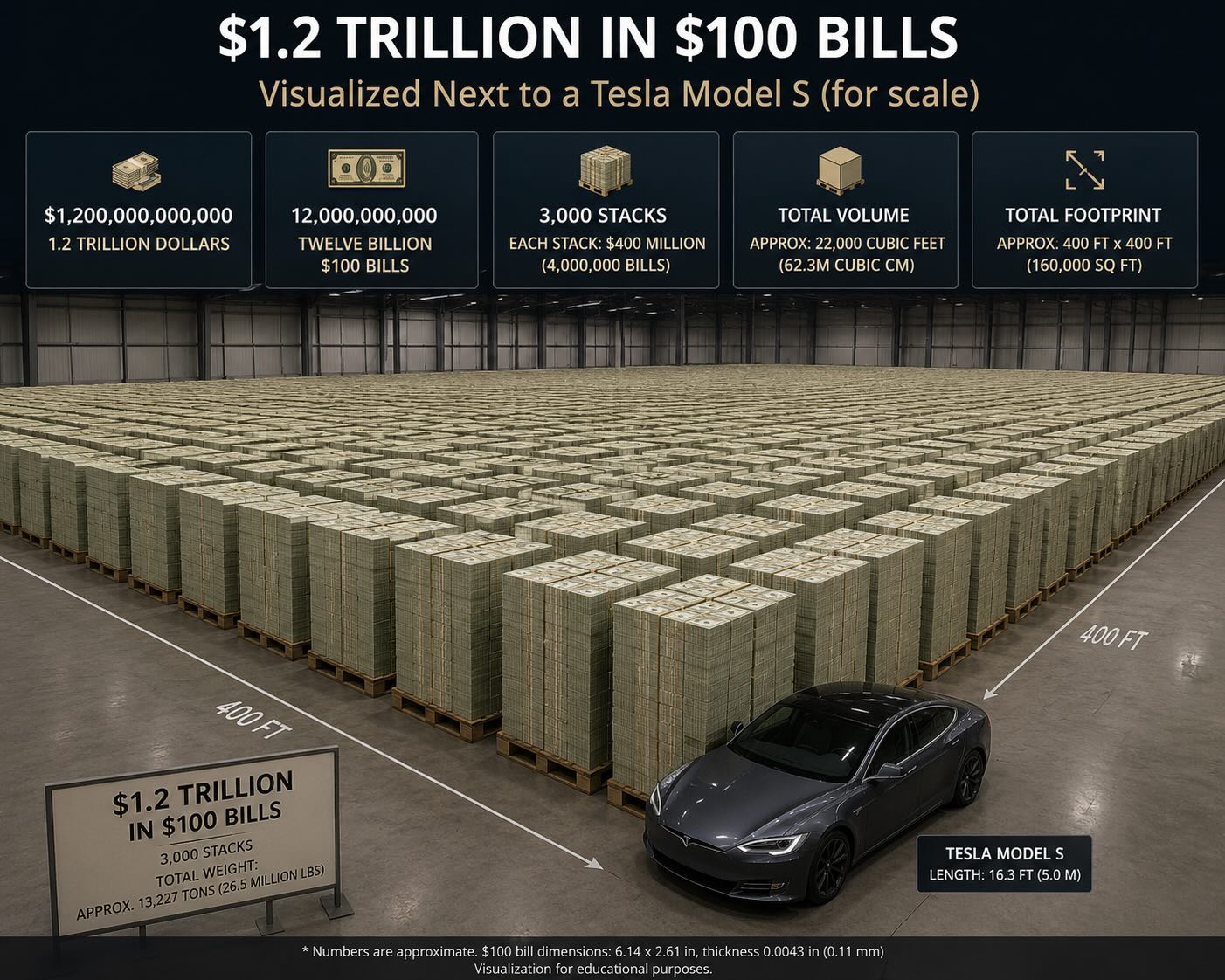
If Musk's fortune were converted into $100 bills, it would amount to 12 billion banknotes. Stacked one atop another, the pile would rise more than 50,000 miles into the sky—enough to circle the Earth several times. Spread out in neat stacks, the money would cover an area resembling a small city rather than a bank vault.
Or think about counting it.
Most people know that a million dollars is a lot of money. If you counted one dollar every second, day and night, it would take about 11 days to reach one million dollars. To reach one billion dollars would take nearly 32 years. To count to one trillion dollars would require more than 31,000 years—longer than all of recorded human civilization.
Gold offers another perspective.
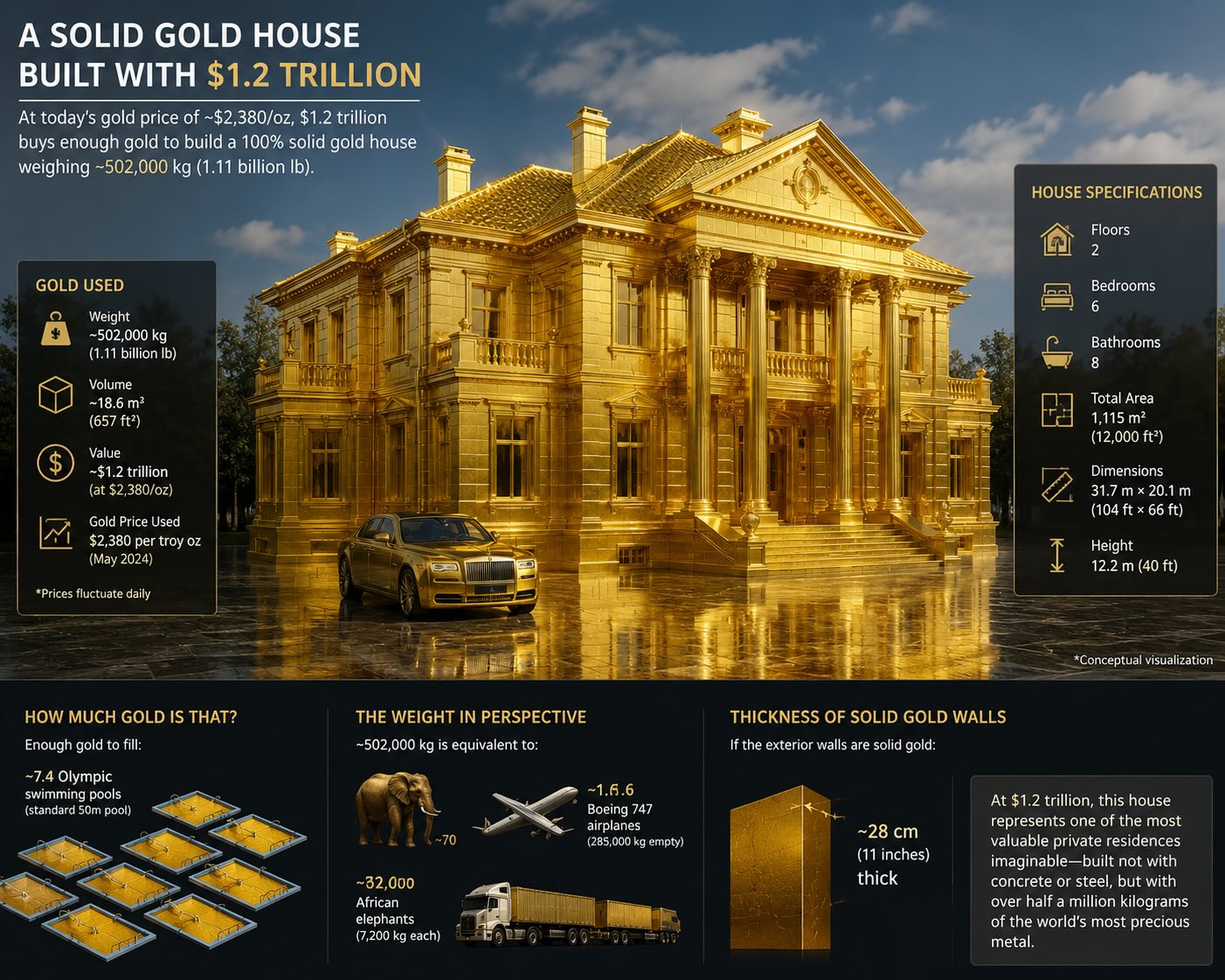
At current prices, $1.2 trillion could purchase roughly 6,500 metric tons of gold. That is enough gold to build a substantial mansion made entirely of solid gold. Not gold-plated. Not decorated with gold. Solid gold walls, floors, ceilings, staircases, and roof. The resulting structure would look less like a house and more like a modern-day pharaoh's palace.
The numbers become even stranger when compared to infrastructure.
A modern subway line can cost hundreds of millions of dollars per mile to construct. Using average global construction costs, $1.2 trillion could fund a subway stretching from New York to Los Angeles. At the extraordinarily high costs sometimes seen in major American cities, it would still pay for a significant portion of such a project.
Then there is copper.
If Musk's entire fortune were converted into U.S. pennies, approximately 120 trillion coins would be required. Even though modern pennies contain only a small amount of copper, manufacturing them would consume roughly one-third of the world's annual copper production. Using old-style copper pennies would require years of global copper output.
Yet perhaps the most astonishing comparison involves people.
The combined wealth of hundreds of millions of the world's poorest individuals would be needed to equal $1.2 trillion. Depending on how one measures net worth, it could take the accumulated assets of a population larger than that of the United States to match a fortune of this size.
Of course, Musk does not actually possess mountains of cash, gold mansions, or oceans of pennies. Most of his wealth exists as ownership stakes in companies, primarily Tesla and SpaceX. Its value rises and falls with markets and investor expectations.
Nevertheless, the exercise is revealing. A trillion dollars is not merely a larger version of a billion dollars. The gap between a billionaire and a trillionaire is so vast that familiar comparisons begin to break down.
At that level, wealth ceases to be something that can be pictured as a bank account. It becomes a quantity measured in cities, natural resources, national infrastructure projects, and entire populations.
That is what makes a trillion dollars so fascinating, perplexing, and, in a way, almost impossible to comprehend.